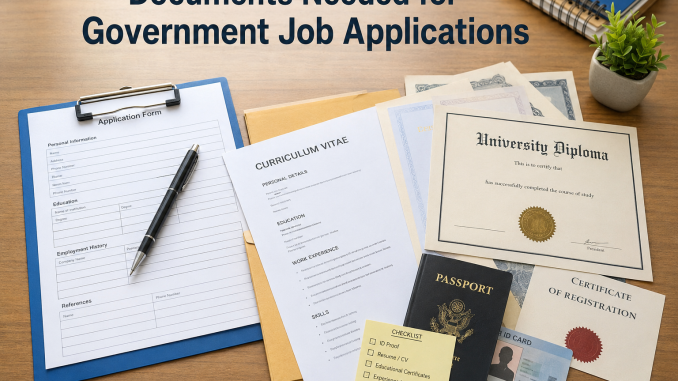
Documents Needed for Government Job Applications: A Complete Guide for Job Seekers
Government jobs remain among the most sought-after career opportunities because they offer stability, competitive salaries, benefits, and long-term career growth. Whether you are applying for a position in local government, provincial departments, national ministries, law enforcement agencies, healthcare institutions, or public schools, having the correct documents ready is essential.
Many applicants miss out on opportunities simply because they fail to submit the required paperwork or provide incomplete information. Understanding which documents are needed before applying can help you avoid delays and increase your chances of success.
This guide explains the most common documents required for government job applications and provides tips on preparing them correctly.
Why Documents Are Important in Government Job Applications
Government recruitment processes are often more structured and regulated than those in the private sector. Employers must ensure that every applicant meets the minimum requirements and that all hiring procedures are fair and transparent.
Documents help hiring departments verify:
- Your identity
- Educational qualifications
- Work experience
- Professional certifications
- Citizenship or residency status
- Criminal record status
- Eligibility for the advertised position
Submitting accurate and complete documents demonstrates professionalism and attention to detail, qualities that government employers highly value.
1. Identity Document (ID)
One of the most important documents required for a government job application is a valid identity document.
Applicants are usually required to submit:
- A certified copy of a national identity card
- A certified copy of a passport (where applicable)
- A residence permit for non-citizens applying for eligible positions
Your ID helps employers confirm your identity and verify your eligibility to work in the country.
Tips
- Ensure the copy is clear and readable.
- Check that the certification stamp is valid.
- Verify that personal details match the information on your application form.
2. Updated Curriculum Vitae (CV)
A Curriculum Vitae (CV) provides a summary of your educational background, work experience, skills, and achievements.
A strong government job CV should include:
Personal Information
- Full name
- Contact number
- Email address
- Residential address
Educational Background
- Schools attended
- Colleges or universities attended
- Qualifications obtained
- Graduation dates
Employment History
- Previous employers
- Job titles
- Employment dates
- Key responsibilities
Skills
- Computer literacy
- Communication skills
- Technical skills
- Language proficiency
References
Include professional references who can verify your work history and character.
Keep your CV updated and free of spelling or grammatical errors.
3. Certified Copies of Academic Qualifications
Government employers require proof of educational achievements.
Common qualification documents include:
- Matric or high school certificate
- Diploma certificates
- Degree certificates
- Postgraduate qualifications
- Professional certifications
Applicants should submit certified copies of all relevant qualifications listed in the job advertisement.
Why These Documents Matter
Employers use qualification documents to determine whether applicants meet the educational requirements of the position.
Submitting false qualifications can lead to immediate disqualification and possible legal consequences.
4. Academic Transcripts
Some government departments request academic transcripts in addition to qualification certificates.
Academic transcripts show:
- Subjects completed
- Grades achieved
- Academic performance
- Date of completion
Graduate recruitment programs and internships frequently require transcripts to assess candidates’ academic strengths.
Preparation Tip
Request official transcripts from your educational institution well before application deadlines.
5. Application Form
Many government departments require applicants to complete an official application form.
The form may request:
- Personal information
- Educational history
- Employment history
- References
- Declaration of information accuracy
It is important to complete every section accurately.
Common Mistakes to Avoid
- Leaving sections blank
- Providing incorrect contact information
- Forgetting to sign the form
- Submitting outdated versions of forms
Always read instructions carefully before submitting.
6. Cover Letter
Although not always mandatory, a cover letter can strengthen your application.
A cover letter should:
- Introduce yourself
- Mention the position you are applying for
- Explain your qualifications
- Highlight relevant experience
- Demonstrate enthusiasm for public service
A well-written cover letter can help distinguish you from other applicants.
Cover Letter Tips
- Keep it concise.
- Address it to the correct department.
- Focus on your suitability for the role.
- Proofread carefully.
7. Proof of Residence
Certain government positions require proof of residence, especially when vacancies are intended for specific communities or regions.
Accepted proof of residence documents may include:
- Utility bills
- Municipal statements
- Bank statements
- Lease agreements
The document should clearly display your name and residential address.
8. Driver’s License
Many government positions require employees to travel regularly.
Examples include:
- Inspectors
- Field officers
- Health workers
- Law enforcement personnel
- Community outreach officers
Applicants may need to submit a certified copy of their driver’s license.
Important Reminder
Ensure your driver’s license is valid and not expired.
9. Professional Registration Certificates
Certain professions require registration with professional bodies.
Examples include:
Healthcare Professionals
- Nursing council registration
- Medical council registration
Engineers
- Engineering council registration
Teachers
- Teaching council registration
Accountants
- Professional accounting body registration
Employers often require proof that registrations are active and current.
10. Work Experience Certificates
Work experience certificates verify your previous employment history.
These certificates typically include:
- Employer name
- Position held
- Employment dates
- Duties performed
Work experience documentation helps employers assess whether applicants possess the practical experience required for a position.
Benefits of Including Experience Certificates
- Strengthens credibility
- Confirms employment history
- Supports information listed on your CV
11. Reference Letters
Reference letters provide independent confirmation of your abilities and character.
References may come from:
- Previous supervisors
- Managers
- Academic lecturers
- Professional mentors
Strong references can significantly improve your application.
What Makes a Good Reference Letter?
A quality reference letter should:
- Describe your skills
- Highlight achievements
- Confirm your work ethic
- Recommend you for employment
12. Police Clearance Certificate
Some government jobs require a police clearance certificate.
This document confirms whether an applicant has a criminal record.
Positions commonly requiring clearance include:
- Law enforcement
- Education
- Finance
- Security services
- Childcare services
Obtaining a police clearance certificate may take several weeks, so applicants should plan ahead.
13. Medical Examination Reports
Certain government positions involve physically demanding tasks or safety-sensitive responsibilities.
Examples include:
- Police officers
- Firefighters
- Military personnel
- Emergency responders
Applicants may need to undergo medical examinations and provide reports confirming their fitness for duty.
Typical Assessments
- Vision tests
- Hearing tests
- Physical fitness assessments
- General health evaluations
14. Employment Equity Documents
In some countries, government departments follow employment equity policies aimed at promoting workplace diversity and inclusion.
Applicants may be asked to provide supporting documents related to:
- Disability status
- Veteran status
- Other categories specified by policy
These documents help departments comply with legal employment requirements.
15. Portfolio of Work
For specialized positions, applicants may need to submit evidence of previous work.
Examples include:
Graphic Designers
- Design portfolios
- Creative projects
IT Professionals
- Technical projects
- Software development samples
Researchers
- Publications
- Research reports
A strong portfolio provides practical evidence of skills and expertise.
Tips for Organizing Your Application Documents
Proper organization can improve the quality of your application.
Create Digital Copies
Scan all important documents and save them securely.
Use Clear File Names
Examples:
- ID_Copy.pdf
- CV_John_Smith.pdf
- Degree_Certificate.pdf
Keep Certifications Updated
Many departments require certified documents issued within a specific timeframe.
Check Application Requirements
Different government departments may have different requirements.
Always review the job advertisement carefully before applying.
Submit Before the Deadline
Late applications are often rejected automatically.
Avoid last-minute submissions by preparing documents in advance.
Common Reasons Government Applications Are Rejected
Many qualified candidates are disqualified because of avoidable mistakes.
Common reasons include:
- Missing documents
- Incomplete application forms
- Uncertified copies
- Incorrect information
- Expired certifications
- Late submissions
- Failure to meet minimum requirements
Reviewing your application thoroughly before submission can help prevent these issues.
Final Thoughts
Applying for a government job requires more than simply submitting a CV. Employers need comprehensive documentation to verify your qualifications, experience, and eligibility. Preparing these documents in advance can make the application process smoother and reduce stress when opportunities arise.
Essential documents typically include an identity document, updated CV, academic qualifications, transcripts, application forms, proof of residence, driver’s license, professional registrations, work experience certificates, reference letters, police clearance certificates, and other supporting materials depending on the position.
By keeping your documents organized, updated, and readily available, you will be better prepared to respond quickly to government job opportunities and improve your chances of securing a rewarding career in public service.
Leave a Reply